
Northstar Bridging Interpretation

It is not uncommon to see schools use a test as a filter for admissions. A test or an interview is used to decide who gets in and who stays out. At Northstar, we see it differently. For us, the admission process isn't a gate, it is a bridge. For early childhood (preschool and early primary grades) we have designed a unique, multi-modal process that we call Bridging Interpretation (BI).
Preamble
To begin an interpretation process, we must establish some first principles and ‘givens’ - things that we believe are foundational to any outcome of the interpretive process. Principles that we keep in consideration are as follows:
- Quality of life experienced during infancy and early childhood has a significant effect on subsequent development
- Serious medical, biological, and environmental problems demand swift attention and remediation
- Early identification of children whose developmental trajectory is delayed or atypical is essential in order to institute timely action to correct or attenuate problems.
- It is possible to make a distinction between children whose development is uneventful and children who are facing serious and persistent developmental challenges.
These four principles form the basis of assessment, evaluation and eventual interpretation of the child’s developmental trajectory.
Our assessment is divided into three parts:
- Interpretation of Developmental Indicators,
- Interpretation of Social-Emotional Learning
- Personal interaction with senior educators
Process
We believe that any diagnostic process that we adopt needs to be a scientific, research-backed approach. We also believe that early and accurate identification of infants and young children who have developmental delays or disorders is key to the timely delivery of early intervention services. Our goal is to establish a comprehensive, first-level interpretation program that can be further extended in a medical, professional setting, if the need be.
We have learnt from our close classroom observations, and also substantiated by research, that:
- Development in most children proceeds at a predictable rate and in a predictable fashion. Most children learn to roll over before they crawl and pull to stand before they walk; however, within such developmental sequences, extensive variations across children can occur (e.g., some children never learn to crawl but do learn to walk without problem)
- If a medical problem occurs when a child is 9 months old, then the condition may have a brief or a lasting effect on the child’s subsequent development.
- The Nature of physiological or environmental conditions cannot be predicted over time. One cannot assume that because a child’s developmental trajectory is on target at 9 months, it will remain on target as the child ages. Similarly, one cannot assume that an infant developing poorly at 4 months will continue to develop poorly over time.
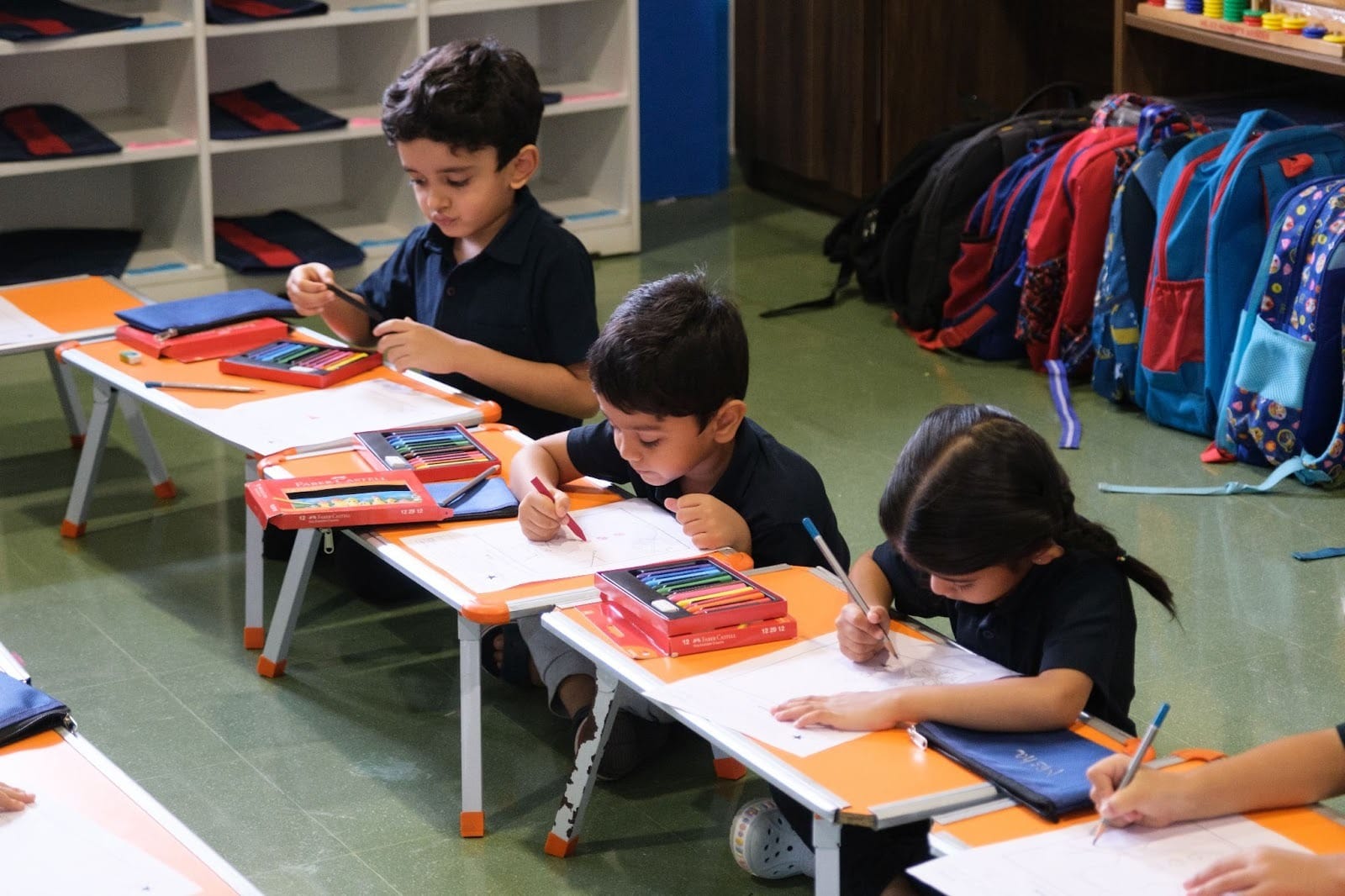
We implement our interpretation process for kids who are planning to join our early childhood programs, from Play Stage all the way to Grade 1. In the interpretation process, we rely heavily on the involvement of parents. Parents know what their children can do. Honest and reliable information from parents forms the key source for our interpretation. We understand that an assessment that takes place outside the home in a relatively short period of time may not yield accurate results on its own because the child’s full range of abilities have not been assessed due to time constraints or the child being in an unfamiliar location. Given this, it is all the more important for parents to provide accurate information to the interpretation team.
The screening assesses a child's development across five key developmental areas:
- Communication
- Example: How the child babbles, talks, and understands language.
- Gross Motor
- Example: Child's large muscle movements, such as running, jumping, and walking up/downstairs.
- Fine Motor
- Example: Child's hand and finger small muscle coordination, such as picking up objects or drawing.
- Problem Solving
- Example: How the child plays with toys and solves simple problems.
- Personal-Social
- Example: The child's social skills and independence, such as eating or getting dressed.
These results help us to identify a child's strengths and potential areas of concern, ensuring that if a child needs a different kind of support, we recognize it immediately. An additional set of questions about the child’s overall health and development are also included to ascertain healthy development of hearing, vision, etc.
In addition to interpretation of the development areas mentioned above, we have designed a process to interpret the child’s social and emotional developmental trajectory. We believe that a child’s ability to regulate their emotions, interact with others, and develop autonomy is just as important as their ability to solve maths problems. We look at:
- Autonomy
- Self-Regulation
- Interaction
- Affect
- Adaptation
Early identification of social-emotional challenges isn't about labelling a child. It’s about identifying behaviors of concern during their most critical years so we can support the parents in providing a supportive and nurturing environment.
Finally, interacting with our senior educators gives insights that cannot be obtained through structure questions or activities. This is the time to understand the subtleties of a child's nature.
Conclusion
Our interpretation team evaluates all the areas based on the child's demonstration and responses to probing questions or activities, and also on parent testimony. Based on all data, we are able to provide a comprehensive interpretation that the parent can use to further support the child. Our Bridging Interpretation is so well-designed and rigorous that it forms an important tool for pediatricians, psychologists and counselors.
We live in an era where knowing is easy, but being is hard. By focusing on the social and emotional health of a child from day one, we aren't just preparing them for school, we are preparing them for life. We aren't just looking at where a child is today. We are looking at the person they are becoming.